Czech Startup Ecosystem 2026: Funding, Tech Hubs, and M&A Landscape

Executive Summary

Czechia operates as a high-income, open EU economy where tech development is shaped by necessity rather than market size. With a trade-to-GDP ratio exceeding 130%, domestic startups are essentially forced to build “export-ready” products from day one. This environment has fostered an ecosystem focused on B2B-software, cybersecurity, and applied deep-tech, designed to mainly enhance the country’s industrial core.

The tech landscape is anchored by three specialized hubs: Prague acts as the headquarters, concentrating 83% of the startup enterprise value; Brno serves as the deep-tech engine room with a focus on cybersecurity and IoT; and Ostrava provides critical infrastructure via the “KarolAIna” supercomputer. Investment dynamics in 2025/2026 reflect this maturity, with startups attracting approximately €540 million, largely driven by high-value “whale” rounds like Mews. M&A remains the primary exit path, totaling €5.65 billion in 2024 as international strategics and private equity consolidate the sector.

Structural risks persist during international scaling, most notably relocation pressure. Approximately one-third of startups consider moving their headquarters abroad to escape high tax burdens and administrative “innovation friction.” This is often a strategic necessity to satisfy foreign investors seeking mature equity structures. Furthermore, a scale-up capital gap frequently forces growing companies to seek lead investors in larger hubs like London or Berlin, often necessitating a relocation of the holding company.

The long-term outlook remains positive as the economy shifts toward a B2B-heavy “Serious Software” hub. A 2026 policy reset featuring a 150% R&D tax allowance makes the country highly competitive for R&D-intensive firms. While a selectivity bottleneck exists for median startups, top-tier Czech assets in industrial AI and cybersecurity continue to attract Tier-1 international capital at global valuations.

Entry snapshot – the discipline of a small market

Czechia’s tech relevance comes from constraint rather than scale. With exports near 70% of GDP and trade well above 100%, the domestic market offers little room for protected growth. Companies that work tend to learn early how to sell, partner, and compete beyond their borders—an instinct that quietly shapes the country’s startup and deal landscape.

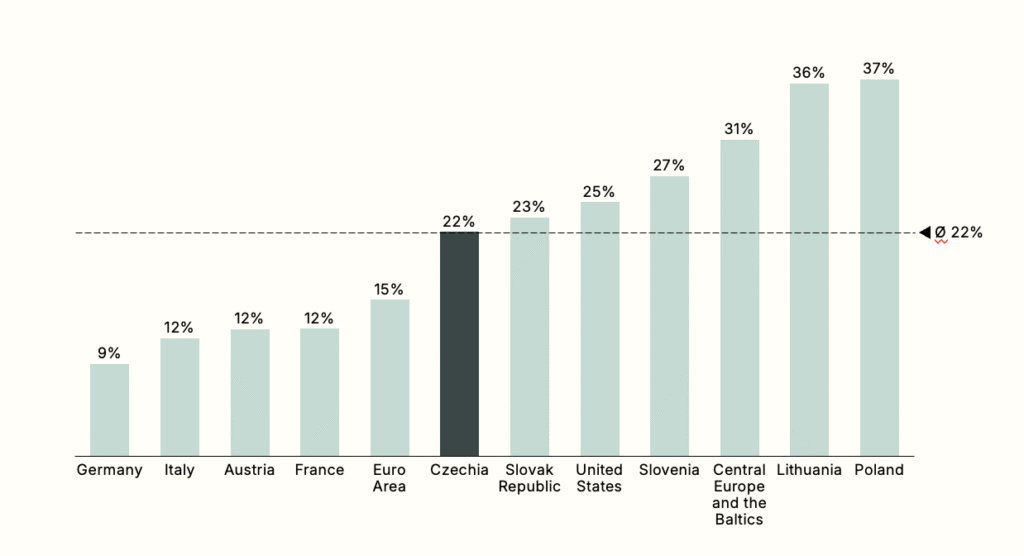
The macro backdrop remains steady rather than spectacular. As a high-income economy (~$429bn GDP), the country has maintained an average growth rate compared to its European peers over recent years. While it hasn’t outperformed the region’s top flyers, it has shown resilience, with growth expected to pick up pace again in 2025. What sharpens the picture is the industrial base. Automotive and advanced manufacturing account for an unusually large share of output, pulling demand toward software that improves margins rather than headlines—automation, security, energy efficiency, supply chains, and applied AI. These are the kinds of technologies that fit into platforms and acquisition strategies.

This has produced an ecosystem biased toward “serious” products. Cybersecurity remains the clearest calling card, but it sits alongside product-led enterprise software and operationally heavy platforms that are built to survive scrutiny, not just grow users. A strong digital skills base supports this pipeline; the harder question is how fast these companies can widen distribution and professionalise for international buyers.

Interest from outside the country is rising for familiar reasons: industrial transformation across Europe, uneven digitalisation that creates room for B2B adoption, and a shifting policy backdrop following the December 2025 change in government. None of this guarantees outsized outcomes – but together it explains why Czech tech assets often appear on cross-border shortlists. It is a market where scale is rare, but relevance is learned early.

Cumulative GDP Growth 2015-2024 – Comparison across Europe


3. Start-up hubs in the Czech Republic

3.1 Three major hubs, with Prague on top

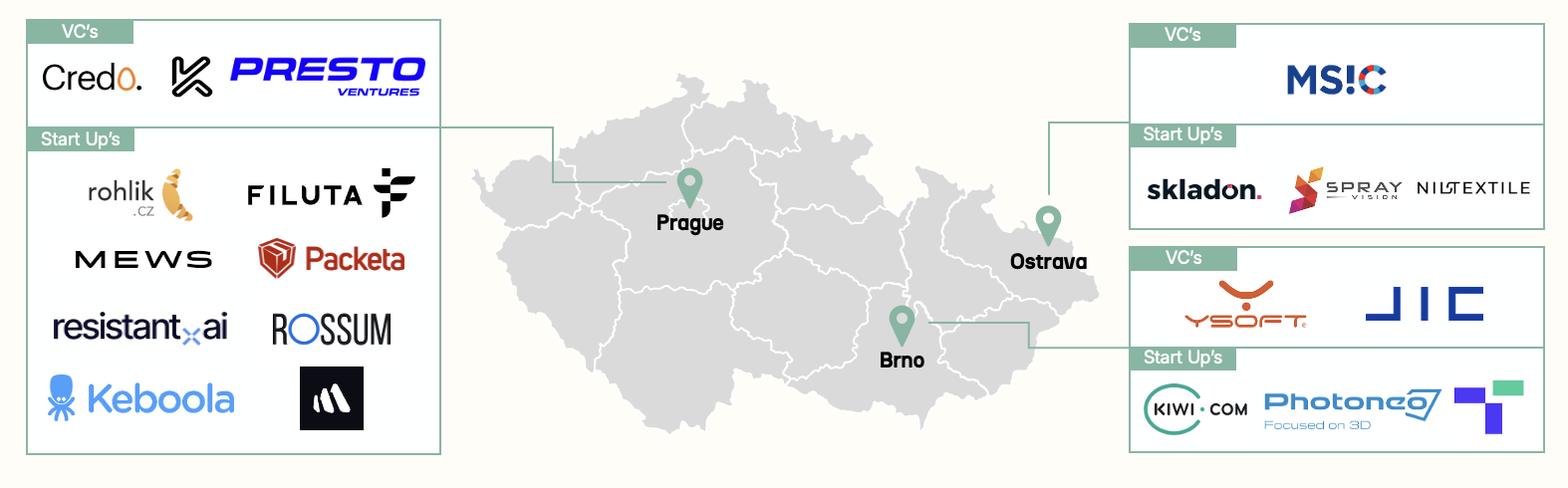
The Czech tech landscape is anchored by three power centers, each playing a distinct strategic role in the ecosystem:

Prague: Prague serves as the undisputed “ecosystem headquarters.” This is where capital and scaling expertise concentrate, particularly in Fintech, SaaS, and Corporate Innovation. With accelerators like Start it @ČSOB and innovation hubs such as Škoda X, the city is the primary destination for founders seeking proximity to investors, regulators, and large B2B buyers.

Brno: The region is widely regarded as the most “organized” ecosystem in the country. Driven by the JIC (South Moravian Innovation Centre), Brno has established itself as a stronghold for Cybersecurity, IoT, and semiconductor technology. Through tight links with top-tier research centers like CEITEC, the region produces technologically complex solutions that often achieve global niche leadership.

Ostrava: Ostrava leverages its industrial DNA to lead in digital transformation. The centerpiece is the IT4Innovations National Supercomputing Center, which anchors the “Czech AI Factory” project. By hosting the AI-optimized supercomputer “KarolAIna,” the region provides the actual compute power and infrastructure necessary for high-scale AI startups and applied industrial research.
4. Funding: Plenty early, thinner later

4.1 Where the money actually went

Even though Czechia’s local ecosystem is structurally strongest at pre-seed/seed, recent funding data shows that meaningful capital does get deployed into Czech-founded companies — often with international investors or cross-border syndicates involved.

Top rounds in 2025 (selected)
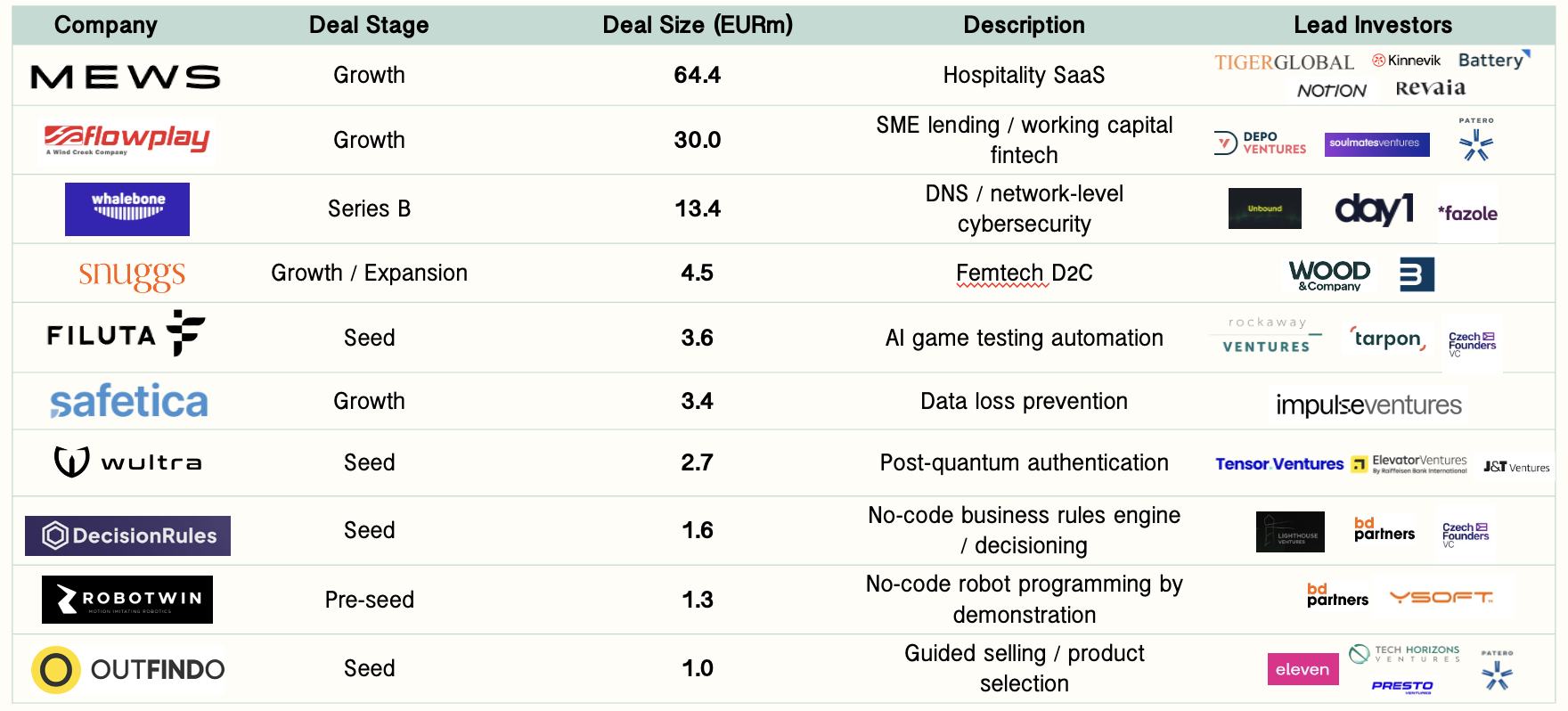
Based on H1 2025 deal evidence, Czechia’s funding highlights a skew toward pragmatic, exportable B2B products rather than purely local-market consumer plays. A notable cluster appears in cybersecurity (e.g., Whalebone, Safetica, Wultra), alongside vertical/enterprise software and infrastructure themes (Mews in hospitality operations, DecisionRules in business rule automation, Flowpay in SME financing). At the upper end, the largest rounds tend to be internationally syndicated, reinforcing the pattern that late-stage capital is available but often requires cross-border investor access and narrative positioning.

4.2 Key dynamics

The Czech tech economy exhibits a top-heavy structure where massive value concentration in Prague sits alongside significant structural hurdles. The capital remains the undisputed engine of growth, with an ecosystem value of €19.2 billion, representing roughly 83% of the national total. This concentration is especially visible in the AI sector, which now secures nearly one-third of all venture capital funding in the country.

Despite this success, 2026 data highlights deep-seated friction points. Approximately 72% of founders cite the tax burden as a primary barrier, while 64% point to excessive bureaucracy. These challenges have led a third of startups to consider or complete a move of their headquarters abroad. Furthermore, the era of the “cheap engineer” has ended; average ICT salaries reached 94,000 CZK in 2024, and senior roles in Prague now frequently exceed 125,000 CZK, driven by high demand and rising government salary thresholds for foreign talent.

Finally, the investor landscape faces a “selectivity bottleneck.” While top-tier companies thrive, 62% of local investors report a lack of high-quality, investment-ready startups. This has created a stark divide, where elite assets price globally and attract international interest, while median startups face a much tougher and more cautious fundraising environment.

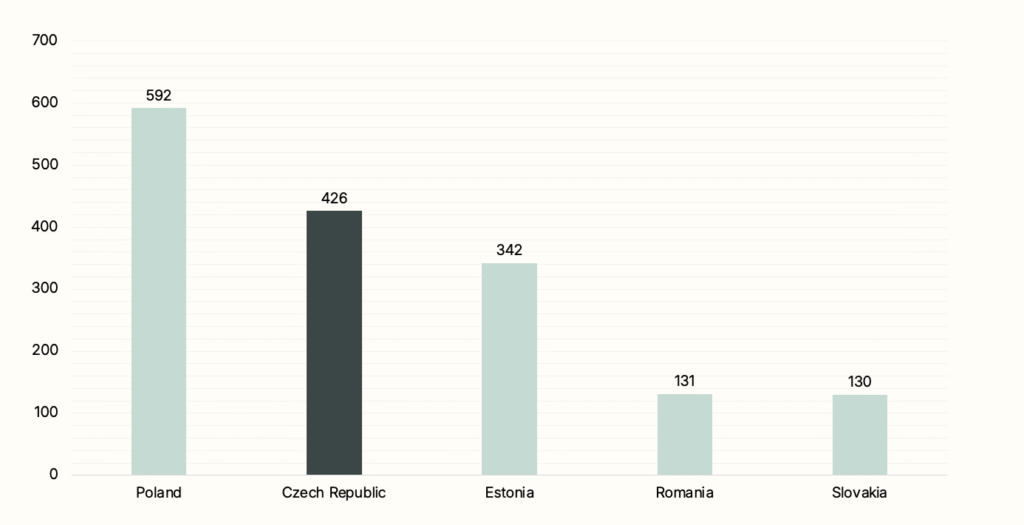
This competitive landscape is best understood within the broader regional context of Central and Eastern Europe. While Czechia faces internal pressures, it remains a dominant force in the region, often vying for the top spot in total investment value. The following table illustrates how Czechia’s funding volume and ecosystem maturity compare to its neighbors.

VC funding Comparison –  Eastern Europe (in EURm)
5. M&A: Buyers come from outside

5.1 The Exit Strategy: Trade Sales as the Default Path

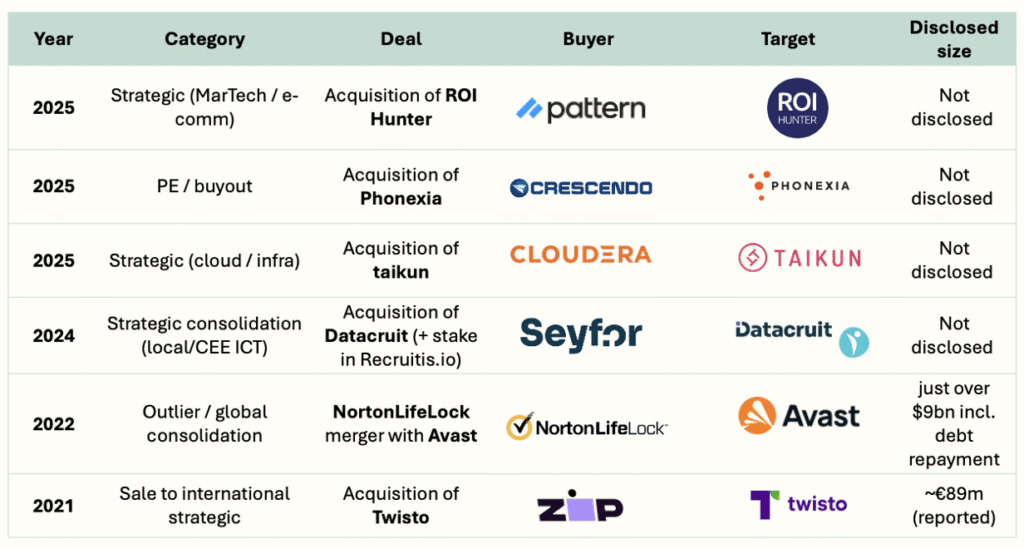
For the vast majority of Czech tech companies, trade sales to strategic buyers remain the primary exit route. While “mega-deals” like the $9B Avast-NortonLifeLock merger prove that Prague can produce global giants, most successful outcomes are mid-market cross-border acquisitions. In 2024, the broader Czech M&A market recorded approximately 128 deals with a total value of €5.65B, with software and IT services consistently ranking as the most active sub-sectors.

For founders, exits typically fall into three distinct categories. Cross-border M&A is the standard “VC-style” win, where international strategics acquire Czech startups for their technical talent and European market access. A classic example is the acquisition of Prague-based fintech Twisto, which was first acquired by Zip for €73.8M and subsequently sold to Turkish unicorn Param in a strategic reshuffle. Secondly, Private Equity (PE) is increasingly dominant for scaled platforms. The recent acquisition of Packeta (Zásilkovna) by a consortium of CVC Capital Partners and EMMA Capital highlights PE’s role in rolling up regional winners into international logistics powerhouses. The following section provides an overview of some of the most significant transactions in recent years.

Noteworthy Tech(-enabled) M&A / Exits
5.2 The Buyer Universe: Who is Buying?

Czech tech M&A is fundamentally international. Local corporate buyers are active but tend to focus on smaller, early-stage “capability captures” or talent-driven acqui-hires that rarely make global headlines. The most liquid and high-value exits involve one of two types of international players:

International Strategics: These buyers treat Czech startups as “plug-and-play” growth engines. They buy a finished product and a high-performing engineering team to scale through their existing global distribution channels.

PE & Growth Equity: Financial sponsors have moved from being observers to active “buy-and-build” architects. They focus on tech-enabled infrastructure and logistics assets where they can apply operational upgrades and consolidate fragmented regional markets.

The practical reality for founders is clear: building for an exit requires building for cross-border relevance from day one. Companies with international governance, reporting standards, and customer bases command significantly higher premiums because they appeal to a much wider set of liquid buyers outside the domestic market.

5.3 Consolidation vs. Acqui-hires

The current cycle is defined by fewer, more strategic “platform” bets rather than a high volume of small acqui-hires. Consolidation is the dominant theme in the 2025/2026 market, particularly in the software and IT services sector. While the “Avast-class” outliers remain rare, they provide the necessary credibility to the ecosystem, proving to global LPs that Czech-founded companies can survive the scrutiny of multi-billion dollar strategic consolidations. The defining story of the Czech market is no longer “buying engineers on the cheap,” but rather acquiring “mission-critical capability” with a clear plan for global scaling.


6. Structural realities and outlook

6.1 The Czech Tech Engine: Hubs, Funding, and Exits

The Czech tech landscape is anchored by three specialized hubs: Prague serves as the headquarters, concentrating 83% of the startup enterprise value; Brno acts as the deep-tech engine room, dominating in cybersecurity and engineering; and Ostrava provides critical AI infrastructure via the “KarolAIna” supercomputer.

Investment and exit dynamics in 2025/2026 reflect a maturing market where startups attracted approximately €540 million in 2025, largely driven by high-value “whale” rounds. M&A activity remains robust, with €5.65 billion in deal value recorded in 2024, as international strategics and private equity firms continue to consolidate the software and IT services sectors.

6.2 Structural Risks: The Scaling Gap

Despite a high-quality technical foundation, the ecosystem faces significant structural risks during the transition to international scale. The most pressing challenge is relocation pressure, with approximately one-third of startups considering or completing a move of their headquarters abroad to escape high tax burdens and rigid labor laws. This migration is often a strategic necessity to appease foreign investors who remain cautious of the local legal framework and seek jurisdictions with more mature equity incentive structures.

From an administrative perspective, the ecosystem is hindered by innovation friction, where excessive paperwork and slow government digitalization act as a tax on speed. This is especially evident during the scaling phase, where hiring senior international leadership is often delayed by restrictive visa processes. Furthermore, a persistent scale-up capital gap forces growing companies to seek foreign lead investors in hubs like London or Berlin, which further accelerates the pressure to relocate holding companies to the UK or Delaware.

6.3 Outlook: The Next Wave of Applied AI

The long-term identity of the Czech tech economy is shifting toward a B2B-heavy “Serious Software” hub, where applied AI and enterprise solutions outperform consumer-led plays. The 2026 policy reset is a key driver, as the research allowance has increased to 150% for eligible costs, making the country a highly competitive destination for R&D-intensive companies. While the investor landscape remains a selectivity bottleneck, the best Czech assets—particularly in cybersecurity and industrial AI—are increasingly pricing at global levels and attracting Tier-1 international capital.

Picture of Stefan Köppl
Stefan Köppl

Tech M&A advisor with a background in venture capital and international M&A, and an academic track record as a published researcher and speaker in Europe.

share this post:

LinkedIn
Twitter
Facebook

Related Posts

Sebastian Beck

His professional experience spans management consulting, corporate strategy, and corporate law.

Before joining Samira Advisors, he worked at REWE Inhouse Consulting, where he contributed to transformation projects across various business units. He also gained legal and analytical experience at a corporate law firm and co-founded a student initiative focused on consulting, finance, and entrepreneurship. 

Through his studies at WU Vienna, Sebastian combines his interests in sustainability and corporate restructuring, aiming to understand how companies can navigate crisis, transformation, and long-term value creation through a strategic and responsible lense.