Hungary Tech Ecosystem 2025: Startup Funding, M&A, and What Comes Next

Executive Summary

Hungary’s economy has been struggling since 2023. Investment fell sharply and a real recovery is not expected before 2027. Budapest is home to over 70% of startup activity, while Szeged and Debrecen are much smaller players.

In 2025, the number of deals went up but the total amount of money raised went down by nearly 46%. Most of the capital that did flow went into cybersecurity, AI, and B2B software, and most of it came from outside Hungary.

The bigger story is this: the best Hungarian founders are not trying to win at home. They use local engineering talent to build products for international markets, and they raise money from foreign investors to do it.

1. Economic Trends and the Shift Toward Innovation

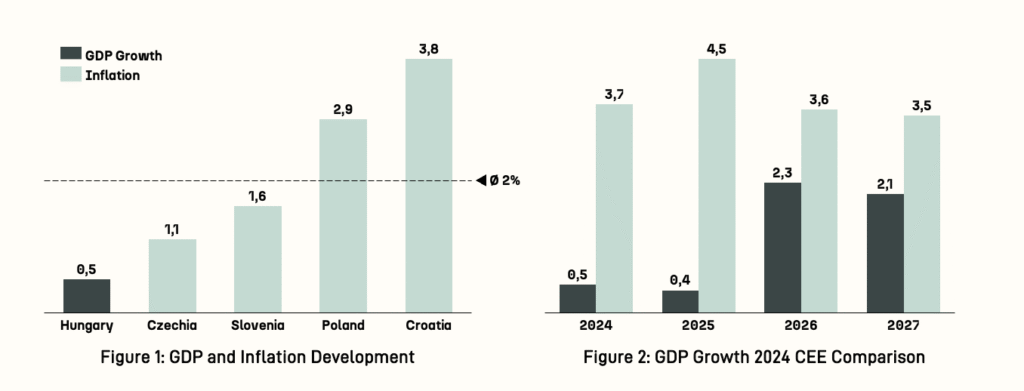
Hungary’s economy has been slow to recover after a difficult couple of years. Growth in 2025 was limited, and while things are expected to improve in 2026 and 2027, inflation is still high (Figure 1).

The contrast with neighbouring countries is clear. Poland and Croatia are both growing at over 3%, while Hungary is lagging behind (Figure 2). Most of the growth that does exist is coming from consumer spending, helped along by higher wages and planned tax cuts. Business investment is a different story: it has dropped nearly 20% since early 2023 and is not expected to recover until 2027.

On the industrial side, Hungary has made a big bet on electric vehicles and batteries. Weak demand from Germany and the rest of the Eurozone has kept production below capacity for now, but this is still central to Hungary’s export plans as new facilities come online.

Business and Industrial Services was the most active sector for deals in the first half of 2025. Together with growth in Agriculture Tech and consumer electronics, this points to an economy that is gradually changing shape.

This shift is also showing up in the startup world. As traditional industries face pressure, founders are moving toward high-tech B2B products. Today, 36% of Hungarian startups are focused on artificial intelligence. That number tells you something about where things are headed.
2. Start-up hubs in Hungary

2.1 Budapest: The Centre of the Hungarian Startup Scene

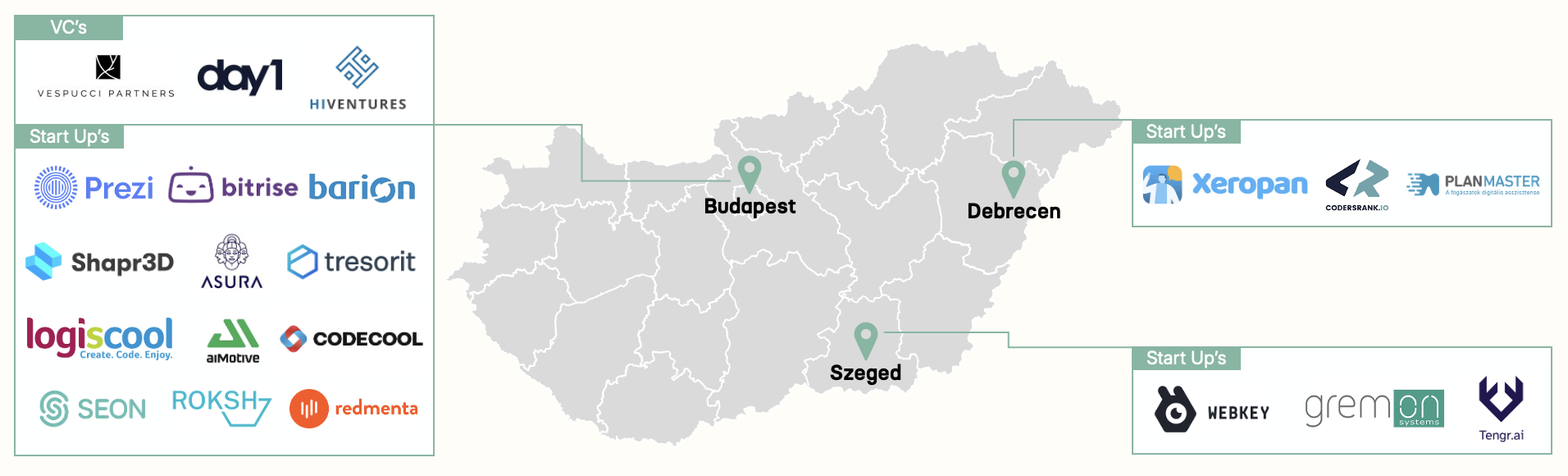
Budapest is where almost everything happens. More than 70% of Hungarian startups are based there or run their main operations from the capital. It has the investors, the talent networks, and the infrastructure. Experts see it as the main gateway connecting Hungarian founders to markets in the US and UK.

Szeged and Debrecen are the next largest hubs, but they operate at a much smaller scale. Both have their own startup communities, but neither comes close to Budapest in terms of deal flow or resources.

One trend is worth noting: when a startup outgrows Budapest, it rarely moves to another Hungarian city. The next step is usually London or another major European hub. This reflects both the limits of the home market and the international ambitions of the founders building there.

Hungary has a small number of high-profile startup events, and most of them take place in Budapest. This reinforces how centralised the ecosystem is.

  • Budapest Startup Safari opens Budapest’s startup and VC offices to international visitors.
  • Brain Bar Budapest is a large tech and ideas event that attracts an international audience.
  • Startup Weekend Budapest and Startup Grind Budapest keep the local community active throughout the year.

2.2 Key Events in the Ecosystem

Hungary has a small number of high-profile startup events, and most of them take place in Budapest. This reinforces how centralised the ecosystem is.

  • Budapest Startup Safari opens Budapest’s startup and VC offices to international visitors.
  • Brain Bar Budapest is a large tech and ideas event that attracts an international audience.
  • Startup Weekend Budapest and Startup Grind Budapest keep the local community active throughout the year.

3. Funding

3.1 Where the Money Went

In 2025, investors focused on a narrow group of Hungarian startups: those building tools for businesses, particularly in security, compliance, AI, and software infrastructure. Consumer apps were not the priority. Investors wanted specialized products with paying customers outside Hungary.
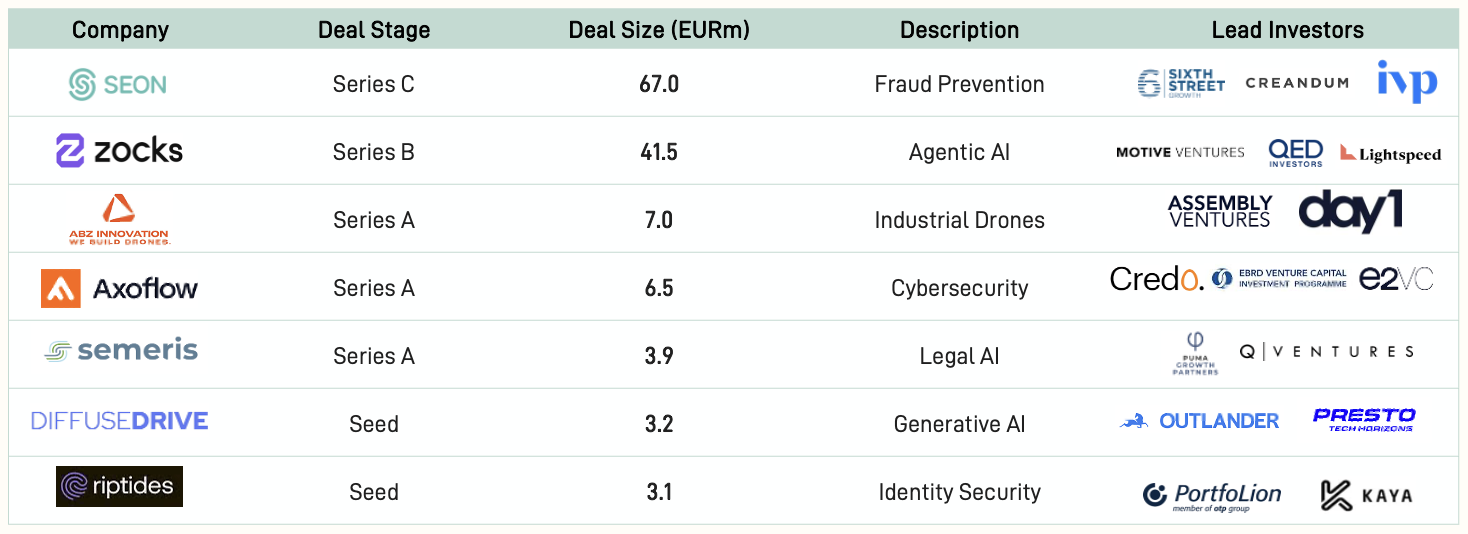
The companies that raised the most money follow a similar pattern: strong Hungarian engineering teams, but built and funded with international markets in mind. Axoflow and Riptides in cybersecurity. Zocks and DiffuseDrive in AI. These are the companies that represent Hungarian tech to the rest of the world.

3.2 Key Trends

The numbers from the first half of 2025 tell an interesting story. The number of deals rose by 17.5%, but the total amount raised fell by 45.7% compared to the same period the year before. More rounds, but smaller ones on average.

The money that was raised stayed concentrated in a few areas: Business and Industrial Services, consumer electronics, and specialist software. Venture capital accounted for around 72% of deals by number, but growth-stage private equity absorbed more than three quarters of the total capital. Early-stage activity was busy. The big money, however, went to later-stage companies.

The most significant change is in where the capital is coming from. In 2025, a much higher share of rounds included foreign investors compared to 2024, particularly in cybersecurity, AI, and enterprise software. The pattern is now well established: Hungarian teams building for global markets, backed by international investors.

4. M&A in Hungary

4.1 Software Leading the Way

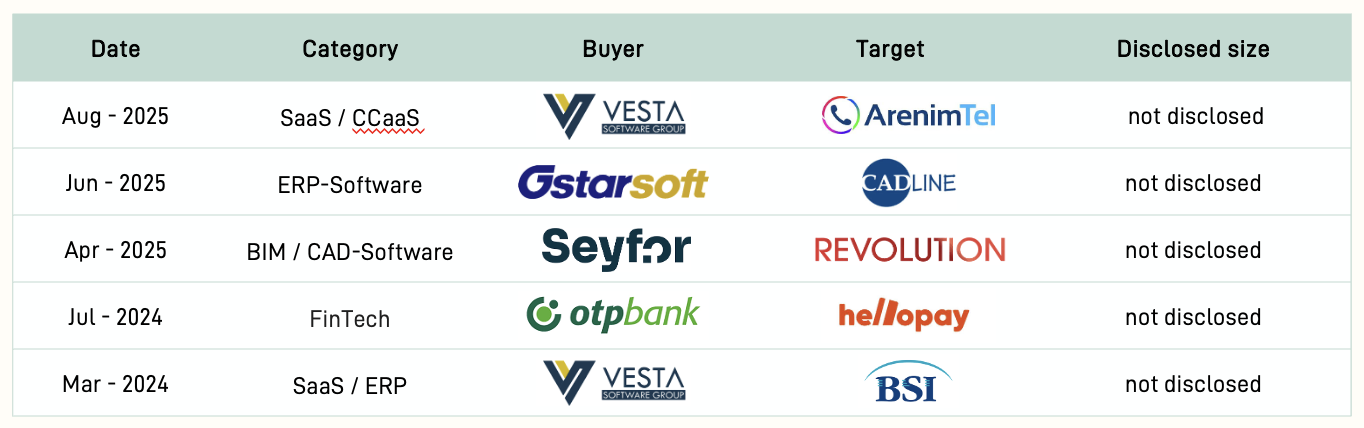
Tech M&A in Hungary is concentrated in software: SaaS, ERP, financial technology, and customer communication platforms. Most deals are mid-sized, and nearly all are private transactions with no public price tag.

The same buyers keep appearing. Vesta Software Group shows up multiple times, running a deliberate acquisition strategy. Seyfor and Gstarsoft are also active. These are not opportunistic deals. These buyers are carefully expanding their portfolios, one targeted acquisition at a time.

The overall picture is of Hungary as a reliable source of specialized software companies within Central and Eastern Europe. There are no blockbuster deals here. Instead, the market is built on frequent, careful acquisitions of profitable niche businesses with solid customer bases and steady revenue.

It is a market that is maturing but still quite fragmented. Value comes from deep product knowledge, focus on specific industries, and thoughtful integration rather than size alone.
5. Conclusion and Outlook

5.1 Where Things Stand

Hungary’s economic situation is still difficult. Investment is low, the recovery is slow, and the country is behind its neighbours in Central and Eastern Europe. At the same time, there is a real shift happening toward electric vehicles, batteries, and business-focused services.

The startup ecosystem reflects this. It is heavily concentrated in Budapest, with Szeged and Debrecen playing much smaller roles.

In 2025, funding meant more deals but less money overall, with smaller ticket sizes and a growing share of foreign capital going to the strongest B2B, cybersecurity, and AI companies. M&A stayed mid-market and selective, led by buyers with clear, repeatable acquisition strategies.

5.2 What to Expect Next

From 2026 onward, the economic environment is expected to improve gradually. But this alone will not solve the ecosystem’s structural problems. The local market is small, public support is limited, and finding growth-stage capital inside Hungary remains hard.

The companies with the best prospects are those that have already stopped waiting for the local market to grow. More and more founders are setting up holding companies abroad early on, often in the UK or US, to make it easier to raise from international investors. This trend is picking up speed.

M&A will remain selective. State-backed capital will continue to play a role in certain sectors. Private equity will keep looking at tech and business services. But the core story of Hungarian tech is not changing: strong engineers, a small home market, and founders who figure out quickly that they need to build for a global audience.

share this post:

LinkedIn
Twitter
Facebook

Related Posts

Rok Rojc

With close to two years of experience in M&A advisory across Ljubljana and Vienna, Rok has worked on sell-side and buy-side mandates with a growing focus on the European tech sector. Along the way, he has developed a real interest in innovative technologies and a deep respect for the founders behind them.

What Rok enjoys most about this work is the people. He is genuinely curious about the journeys behind the businesses he works with, and is always up for a thought-provoking conversation that challenges his thinking, whether it is with a founder explaining their vision, an investor pushing back on a thesis, or a colleague debating an approach over coffee. Having studied in two countries and earned a double degree from SEB Ljubljana and Audencia’s Grande École programme in Nantes, he feels at home connecting with people from different backgrounds and languages.A quiet drive runs underneath all of it, Rok keeps chasing the version of himself he hopes to be ten years from now, knowing he will never quite catch up, and is happy to let that keep him moving.

Outside of work, Rok plays tennis, skis, and is generally up for any kind of sport. He likes to pick up a good book, enjoys a good glass of wine, and spends as much time as he can with family and close friends.

Christoffer Dejaco

With nearly three years of experience in the tech space, spanning venture capital and consulting, Christoffer has developed a strong interest in innovative business models and companies that challenge the status quo. Now, being on the sell side at Samira, he is gaining a new perspective while continuing to work closely with ambitious and experienced founders. He values the opportunity to learn from their journeys and to support them in achieving the best possible outcomes.

Having spent time in several countries during his studies, Christoffer has developed an international mindset and enjoys connecting with people from diverse backgrounds. This exposure continues to shape his curiosity and openness to new ideas and perspectives.

Outside of work, Christoffer enjoys staying active through sports and regularly challenges himself by exploring new disciplines. He is also passionate about traveling, discovering new cultures, and spending time with friends.